


In this article I explain what fractional product marketing actually is, how it compares to a full-time hire, an agency, and a freelancer, and how to tell whether it fits your stage. No pitch, just the honest version of when this model works and when it doesn’t.
A founder asked me last year how to get senior product marketing into her company without adding a six-figure salary she wasn’t ready for. Her product was getting harder to explain, sales kept inventing their own pitches, and the last launch landed with a shrug. She knew what she needed. She just couldn’t justify a full-time hire for it yet.
That gap, real need for senior help without a full-time commitment, is what fractional product marketing exists to fill. The model has grown fast: demand for fractional executives rose 68% year over year heading into 2026, with marketing leaders among the fastest-growing roles. But the term gets used loosely, and most of what’s written about it is sales copy from people selling it. So here’s the plain version.
What fractional product marketing actually is
A fractional product marketing leader is a senior PMM who works with you part-time, usually a few days a week, and embeds in your team rather than working from the outside. “Fractional” describes the time commitment, not the seniority. You get someone who has led positioning, launches, and pricing at scale, working a fraction of a full week, for a fraction of a full-time cost.
The word that matters most in that definition is embeds. A fractional leader sits in your sales calls, joins your product standups, and learns your buyers the way an employee would. That’s the line between this and the alternatives, and it’s worth seeing all four side by side.
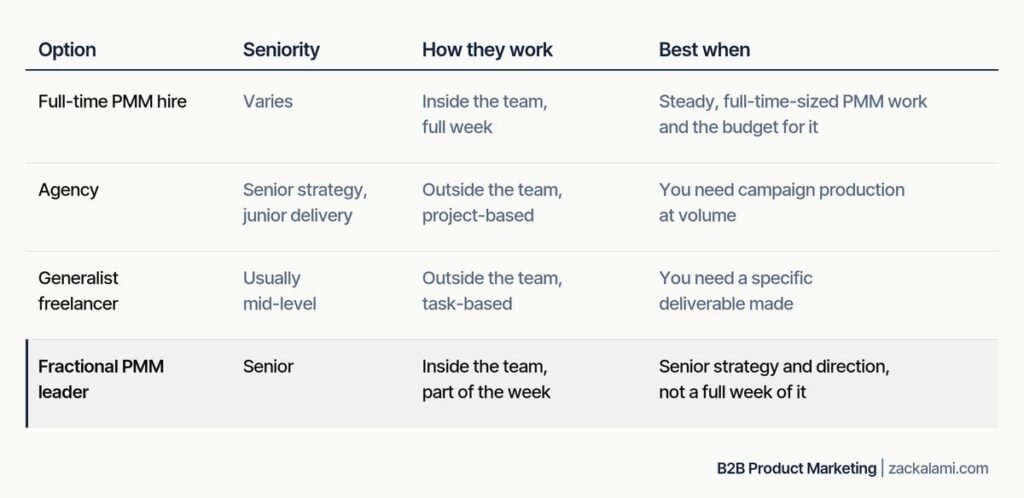
The two contrasts that trip founders up are agency and freelancer. An agency gives you senior thinking in the pitch and junior hands in the delivery, and it works at arm’s length from your buyers. A generalist freelancer gives you a pair of hands for a defined task but rarely the strategic depth to decide what the task should be. Fractional sits where neither does: senior judgment, embedded in your team, applied to the decisions that shape everything downstream.
When it makes sense
The honest answer is a revenue band and a few specific moments.
The band is roughly $1M to $30M in revenue. Below $1M you usually need hands doing the work more than a strategist directing it, and the founder is often still the best product marketer in the building. Above about $25M to $30M, the volume of PMM work justifies a full-time leader, and the math flips in favor of hiring. In between is where fractional fits cleanly: enough complexity to need senior direction, not yet enough to fill a senior person’s week.
The moments matter as much as the band. Fractional tends to earn its cost when:
- You’re raising, and the story has to be tight before it meets investors and the market.
- You’re moving from founder-led sales to a repeatable go-to-market, and someone has to build the positioning and messaging that lets other people sell.
- You’ve made your first marketing hire, a capable generalist, and they need a strategist above them rather than another peer beside them.
- A launch just underperformed, and you suspect the problem was the story, not the product. (It usually is. A launch that stalls is more often a messaging problem than a product one.)
If two or more of those describe you, the model is worth a serious look.
When it doesn’t
The model gets oversold, so here’s where I’d talk a founder out of it.
If you’re pre product-market fit, you don’t need positioning polished; you need to find out whether anyone wants the thing at all, and that’s founder work no fractional leader can do for you. If what you actually need is daily execution, someone to build the emails, run the webinars, and ship the campaigns, a fractional strategist is the wrong shape and an expensive one. And if your problem is demand generation rather than positioning, the channels are working but you need more volume through them, that’s a growth marketing need, not a product marketing one. The two get confused constantly, and hiring the wrong one burns budget on the wrong problem.
“Everyone has one” is not a reason. Hire the model because the work calls for it, not because it’s fashionable.
What it costs
Fractional product marketing typically runs $6,000 to $9,000 a month for a ten-to-fifteen-hour week, with the broader market landing anywhere from $5,000 to $12,000 depending on scope and seniority. Most engagements start at two or three days a week and expand if the value shows.
Set that against a full-time product marketing leader at roughly $180,000 to $250,000 a year plus equity, and the saving is real: 40% to 70% less for senior-level depth, with no recruiting cycle, no onboarding ramp, and no severance risk if the need changes. You’re paying for judgment by the day instead of by the year.
What moves the number is mostly time. Someone with you ten hours a week costs less than someone with you twenty-five. Scope and seniority adjust it from there, but hours are the main lever, which is the point of the model: you buy the fraction of senior attention the problem actually needs.
How an engagement runs
The good ones follow a shape: diagnose, build, hand off.
The first two to four weeks are diagnosis. A senior PMM should be able to tell you what’s actually wrong, in your positioning, your launches, your enablement, within the first month, because they’ve seen the patterns before. The next stretch is building: the positioning, the message map, the launch process, the pricing and packaging that the team will keep using. Meaningful pipeline or revenue impact tends to show in the 90-to-180-day range, because positioning takes time to work through a sales cycle.
The handoff is what separates a good fractional engagement from a dependency. The aim is to leave behind systems your team runs without the fractional leader in the room: documents people reference, processes that repeat, a shared way of talking about the product. The job is to make yourself less necessary, not more.
Frequently asked questions
What’s the difference between a fractional PMM and a fractional CMO?
Scope. A fractional CMO owns the whole marketing function: demand generation, brand, content, team, and budget. A fractional product marketing leader owns the narrower, deeper slice of positioning, messaging, launches, and sales enablement. If your problem is “what do we say and how do we sell it,” that’s PMM. If it’s “who runs all of marketing,” that’s CMO. Smaller companies sometimes need the second; companies with a marketing team but no strategic core often need the first.
How is it different from hiring an agency?
An agency works from the outside and is built to produce volume: campaigns, content, assets. A fractional leader embeds in your team and is built to make decisions: what to say, to whom, and why you win. Agencies are good at execution at scale. Fractional is good at the strategy that should come before execution, the part that, done wrong, makes all that execution amplify an unclear message.
How many days a week is a fractional engagement?
Usually two or three to start, often expanding as the work proves out. The point is to match senior attention to the size of the problem, not to fill a calendar.
How do you measure whether it’s working?
In the first month, by the quality of the diagnosis: does the fractional leader understand your buyers and name your real problems accurately? Over a quarter, by whether sales can tell a clearer story and launches land better. Over two quarters, by pipeline and revenue. Positioning is upstream of those numbers, so it moves them on a delay, not a dime.
Is fractional a stepping stone to a full-time hire?
Often, yes. A common path is fractional first to build the function and prove the value of product marketing, then a full-time hire once the work clearly fills a week. A good fractional leader builds toward that handoff rather than guarding the seat.
I help B2B SaaS companies fix their go-to-market when positioning is unclear, launches don’t land, and sales can’t explain what makes them different. Ten years doing exactly this, scale-up to enterprise. Contact me at zackalami.com/#contact.
Sources
- Cerius Executives, via The Geisheker Group, fractional marketing executive cost and hiring guide 2026: the 68% year-over-year demand growth and cost benchmarks.
- Fractional executive cost analysis 2026, PM Guru: monthly ranges and the time-driven pricing logic.
- PitchKitchen, marketing leader vs agency vs fractional CMO for B2B founders: the revenue-band and break-even framing.
- Kalungi, fractional CMO benchmarks for SaaS: the fractional-CMO scope contrast.