


A CMO recently told me something that stuck: “Building websites is how you make the shortest career in marketing.”
It wasn’t a dig at websites. The point was broader and more uncomfortable. If you define your value by the things you produce (a website, a deck, a campaign, a piece of content), you’ve capped your career at the output level. You become the person who makes things, not the person who understands why those things work or don’t work within a larger system.
That comment reshaped how I think about product marketing. And I believe it’s becoming more relevant, not less, as AI makes output creation faster and cheaper.
The product marketer of the future won’t be valued for creating assets. They’ll be valued for understanding how positioning, sales enablement, customer education, product adoption, and revenue connect as a system, and for knowing where to intervene in that system for maximum impact.
The output trap (and why marketing keeps falling into it)
There’s a pattern I’ve seen in every company I’ve worked at. Marketing gets asked to produce things. A website refresh. A product launch deck. A campaign for Q3. A series of blog posts. A competitive battle card.
Each request is reasonable. Each output has a purpose. But over time, the function becomes defined by its outputs rather than its outcomes. Leadership starts measuring marketing by volume: how many campaigns did you run, how many assets did you create, how much content did you publish?
This is what Casey Winters calls the “CMO death spiral.” Marketing gets trapped in execution. The team produces more and more, but nobody connects the outputs to business results. Leadership loses confidence. Budgets get questioned. The CMO gets replaced. The cycle restarts.
The root problem isn’t bad marketing. It’s that marketing is operating as a production function instead of a systems function. The team is optimizing individual outputs (a better email, a sharper deck, a more creative campaign) without understanding how those outputs interact with each other and with the rest of the business.
A campaign might generate leads, but if the sales team can’t articulate the positioning, those leads die in the pipeline. A product launch might create awareness, but if onboarding doesn’t reinforce the value proposition, adoption stays flat. A battle card might be brilliant, but if it’s not connected to win/loss data and updated regularly, it goes stale in weeks.
Each of those problems looks like an execution failure. It’s actually a systems failure. The pieces aren’t connected.
What systems thinking actually means
Systems thinking is a way of seeing the relationships between things, not just the things themselves.
The concept isn’t new. Donella Meadows, one of the most important systems thinkers of the 20th century, put it simply: “Everything we think we know about the world is a model.” We use maps, theories, metrics, dashboards, and mental categories to make sense of complexity. They’re useful, but they’re approximations. They’re not the thing itself.
The statistician George Box captured it best: “All models are wrong, but some are useful.” Your GTM plan is a model. Your positioning framework is a model. Your pipeline forecast is a model. None of them perfectly represent reality, but the good ones help you act with enough confidence to move forward and enough humility to adjust when the system tells you something different.
Applied to product marketing, systems thinking changes the question you ask. Instead of “what caused this result?” you ask “what set of relationships produced this result?”
A campaign increased sales? Maybe. But maybe price, timing, competitive moves, and product improvements all contributed. A metric improved? Maybe another metric worsened as a consequence. A customer survey says one thing? Maybe actual behavior says something else entirely.
Linear thinking says: we ran a campaign, pipeline went up, the campaign worked.
Systems thinking says: pipeline went up, and the campaign was one of six factors. Which factor had the most leverage? Which ones reinforced each other? Which ones will compound over time?
That second way of thinking is harder. It’s also far more valuable.
GTM is a system, not a collection of activities
Most go-to-market plans are organized as a list of activities. Phase 1: internal enablement. Phase 2: customer communications. Phase 3: public launch. Each phase has deliverables, owners, and dates.
That’s useful for project management. It’s not useful for understanding how your GTM actually works.
A GTM system has interconnected parts that affect each other:
Positioning shapes what sales says on calls. What sales says on calls generates feedback that should reshape positioning. If that loop is broken (sales ignores the messaging, or feedback never reaches PMM), positioning drifts from reality.
Customer education affects product adoption. Product adoption affects retention. Retention affects NRR. NRR affects how much budget you get for next quarter’s campaigns. If you treat customer education as “content creation” instead of seeing it as part of the adoption system, you’ll underinvest in it.
Win/loss data should inform competitive positioning. Competitive positioning should inform battle cards. Battle cards should improve win rates. Improved win rates generate new win/loss data. That’s a reinforcing loop. But most companies break it by treating each piece as a separate deliverable instead of a connected cycle.
Pricing and packaging affect deal velocity. Deal velocity affects revenue recognition timing. Revenue timing affects how leadership perceives marketing’s contribution. If your packaging is too complex, the downstream effects ripple through the entire system, not just through sales.
Internal enablement is the connective tissue most teams underestimate. Sales enablement isn’t a one-time deliverable (a deck, a training session, a battle card). It’s an ongoing system that ensures every customer-facing team can articulate the positioning accurately. When enablement is treated as a project (“we trained the team, we’re done”), the messaging drifts within weeks. When enablement is treated as a system (continuous updates, feedback loops from calls, regular coaching), the positioning stays alive across every customer conversation.
The broader point is that GTM maturity is less about creating better artifacts and more about building systems that keep information, teams, and execution connected over time.
I think about this through three layers.
The first is a GTM overview that creates predictability and builds trust with leadership. It gives a clear view of priorities, timelines, dependencies, and progress so everyone understands where things stand without getting lost in details.
The second is a source of truth (I use Confluence) where GTM aligns with the rest of the organization. This is where briefs, decisions, context, messaging, and evolving plans live. Things move quickly, information changes often, and this becomes the place where knowledge is captured and maintained.
The third is an execution layer (I use Jira) that translates strategy into action, supporting detailed campaign planning, ownership, tracking, and execution across workstreams.
The important point is that the system stays active. It’s continuously updated and connected across layers, rather than living inside a PowerPoint deck that becomes outdated after a single presentation.
When you see GTM as a system, your job changes. You stop asking “what should I build next?” and start asking “where is the system broken, and what’s the highest-leverage intervention?”
Donella Meadows called these “leverage points,” places within a complex system where a small shift produces big changes. In product marketing, the leverage points are rarely the assets. They’re the connections between the assets, the feedback loops, the information flows, and the alignment mechanisms.
Why AI makes systems thinking more valuable, not less
Here’s the shift most product marketers aren’t seeing yet.
AI is rapidly commoditizing the output layer of marketing. Writing a first draft of positioning? AI can do that. Building a competitive comparison? AI can do that. Creating a sales deck, drafting an email sequence, summarizing customer feedback? AI can do all of that, faster and cheaper than a human.
If your value as a product marketer lives in the output layer (I write good copy, I build clean decks, I produce solid content), AI is compressing the gap between you and everyone else. The floor is rising. What used to take a skilled PMM two days now takes anyone with a good prompt 30 minutes.
But here’s what AI can’t do: understand how the pieces connect within your specific business context. AI can write a battle card, but it can’t tell you that the battle card is addressing the wrong competitor because your win/loss data shows you’re actually losing to a different value prop. AI can draft positioning, but it can’t tell you that the positioning won’t land because sales doesn’t trust it, and they don’t trust it because PMM didn’t ground it in buyer research.
Systems-level thinking, understanding the relationships, identifying the broken loops, knowing where to intervene, requires context, judgment, and cross-functional awareness that AI doesn’t have.
This is why I believe the value hierarchy in product marketing is inverting. The further you move from outputs and toward systems, the harder you are to replace and the more impact you create.
- Output level (lowest leverage, most automatable): writing copy, building decks, creating content, designing emails.
- Strategy level (medium leverage): positioning frameworks, message maps, GTM briefs, competitive analysis.
- Systems level (highest leverage, least automatable): designing feedback loops between sales and PMM, connecting customer education to adoption metrics, building repeatable launch processes that improve with each iteration, influencing product decisions through structured customer insight.
The PMMs who operate at the systems level will become more valuable as AI handles more of the output layer. The PMMs who stay at the output level will find their work increasingly commoditized.
What systems thinking looks like in practice
This isn’t abstract. Here’s how systems thinking changes specific product marketing decisions.
Instead of “build a better onboarding email sequence,” ask: what’s the relationship between our onboarding content, time-to-first-value, 30-day retention, and expansion revenue? Where does the system break down? Maybe the emails are fine, but the in-product experience doesn’t reinforce the messaging. Maybe the real bottleneck is that CS doesn’t know the positioning well enough to guide customers through the first week.
Instead of “create competitive battle cards,” ask: what’s our current competitive win rate, which competitors are we actually losing to, what objections come up in those losses, and how does that data flow back to update our positioning? The battle card is one node in a system. If the feedback loop from sales to PMM is broken, the card won’t help regardless of how well it’s written.
Instead of “launch a campaign for the new feature,” ask: what’s the adoption system for this feature? How does awareness connect to trial, trial to activation, activation to retention? Where did the last launch break down, and which intervention would have the highest impact on the weakest link?
Instead of “we need better sales enablement,” ask: why isn’t the current enablement working? Is it a content problem, a distribution problem, a trust problem, or an alignment problem? If sales doesn’t trust the messaging, more content won’t fix it. You need to fix the input (buyer research, co-creation with sales) before fixing the output (the deck, the battle card, the talk track).
Each of these reframes shifts you from an output response (build a thing) to a systems response (find the broken connection and fix it).
How to develop systems thinking as a product marketer
Systems thinking isn’t a talent. It’s a practice. Here are the habits that build it.
Map the loops, not just the deliverables. For your next launch, draw the system. How does positioning connect to sales conversations? How do sales conversations generate feedback? How does that feedback reach PMM? How does it change the next iteration of positioning? If you can’t draw the loop, the loop probably doesn’t exist, and that’s your first problem to solve.
Ask “and then what?” three times. Every output has downstream effects. A new pricing page affects deal velocity, which affects revenue timing, which affects budget conversations. A new battle card affects rep confidence, which affects competitive win rate, which affects market positioning. Tracing consequences past the first order helps you see the system.
Own a metric you can’t directly control. This is counterintuitive, but powerful. If you only own metrics tied to your outputs (email open rates, content downloads), you’ll optimize for outputs. If you co-own a metric like competitive win rate or product adoption, you’re forced to think about the system that produces that outcome, because you can’t move the metric by yourself.
Run retrospectives on the system, not just the launch. After a launch, don’t just ask “did the campaign perform?” Ask “did the system work?” Did the positioning hold through sales conversations? Did the feedback loop from customers reach PMM? Did the launch plan anticipate what actually happened? Retrospectives on the system teach you more than retrospectives on individual assets.
Read outside marketing. Systems thinking originated in engineering, ecology, and organizational theory. Donella Meadows’ “Thinking in Systems” is a good starting point. (Here’s a visual summary I find very useful)
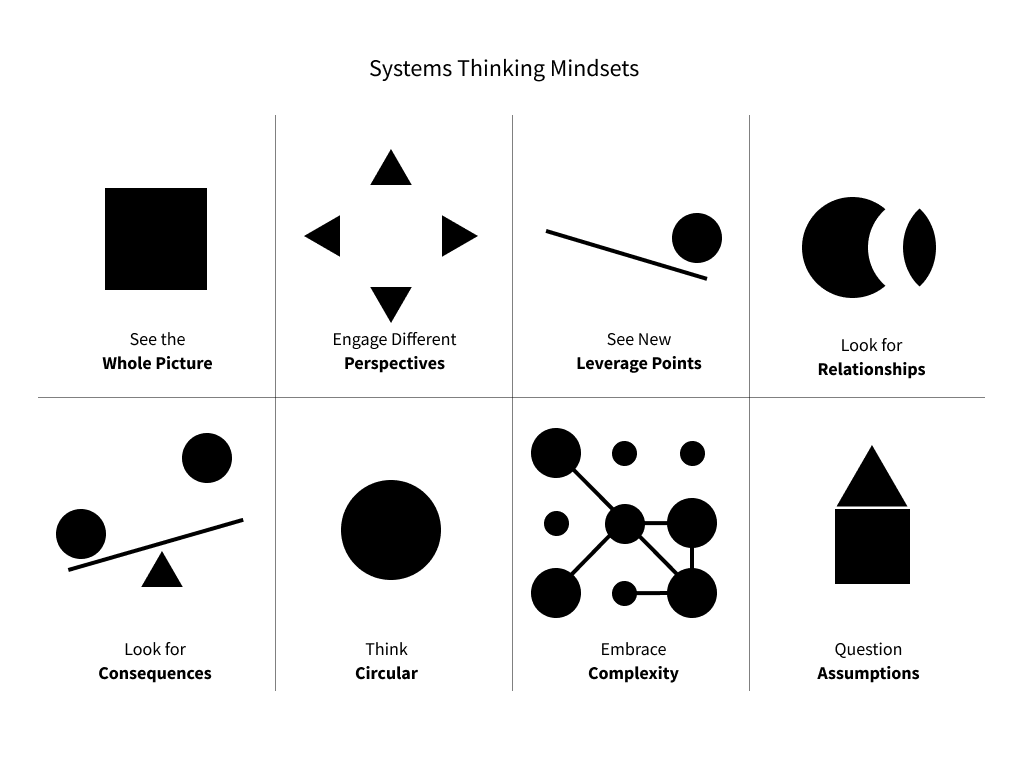
The concepts transfer directly to GTM because go-to-market motions are complex adaptive systems, even if nobody in marketing calls them that.
The career implication
That advice about websites wasn’t really about websites. It was about where you position yourself on the value chain.
If you position yourself as the person who builds things, your career ceiling is execution lead. You’ll be busy. You’ll be productive. But you’ll always be downstream from the decisions that matter.
If you position yourself as the person who understands how the system works, who can diagnose why pipeline is stuck, why adoption is flat, why win rates are declining, and who knows where to intervene for maximum impact, your career ceiling is much higher. You become the person leadership turns to when something isn’t working, not the person they ask to build the next deck.
The product marketer of the future will be less of a content producer and more of a systems architect. Not someone who designs systems in the abstract (that’s too academic), but someone who sees how positioning, enablement, education, adoption, and revenue connect, and who knows which connection to strengthen next.
That’s the skill set that AI can’t replicate. And that’s where the value is heading.
Frequently asked questions
Isn’t this just strategy? Why call it systems thinking?
Strategy typically means “what should we do and why.” Systems thinking is different. It’s about understanding how the parts of your GTM interact and where the leverage points are. You can have a great strategy (target mid-market, lead with security positioning) and still fail if the system that executes it is broken (sales doesn’t trust the messaging, feedback loops don’t exist, customer education is disconnected from onboarding). Systems thinking is what makes strategy work in practice.
How do I explain systems thinking to leadership without sounding theoretical?
Don’t use the term “systems thinking.” Instead, show the connections. “Our win rate dropped because sales isn’t using the updated positioning, because we didn’t build a feedback loop from their calls to our messaging updates.” That’s systems thinking in practice. Leadership doesn’t care about the label. They care about the diagnosis and the fix.
Can I apply systems thinking if I’m the only PMM?
Yes, and it’s arguably more important when you’re solo. With limited bandwidth, you need to know which intervention will have the highest impact. Systems thinking helps you prioritize: instead of building 10 assets, you identify the one broken loop that, if fixed, would make everything else work better. Solo PMMs who think in systems get more done with less.
How does this relate to AI replacing marketing jobs?
AI replaces tasks, not systems understanding. The tasks AI handles best are output-level: drafting, summarizing, formatting, creating first versions. The work AI handles worst is contextual judgment: understanding why a positioning approach failed in a specific market, diagnosing why sales adoption dropped after a reorg, deciding which customer insight to act on and which to deprioritize. The more you operate at the systems level, the more durable your value becomes.
Sources
- Donella H. Meadows, Thinking in Systems: A Primer (Chelsea Green, 2008). The source for feedback loops and leverage points, and for the idea that everything we think we know about the world is a model.
- George E. P. Box, “Science and Statistics,” Journal of the American Statistical Association (1976). Origin of “all models are wrong, but some are useful.”
- Casey Winters, “The CMO death spiral” (caseyaccidental.com). The pattern of marketing getting trapped in execution until leadership loses confidence and the cycle restarts.
I help B2B SaaS companies fix their go-to-market when positioning is unclear, launches don’t land, and sales can’t explain what makes them different. Ten years doing exactly this, scale-up to enterprise. Contact me at zackalami.com/#contact.