

Company: LiveTiles (Omnia) | Type: Go-to-market
PMM Project
AI product launch: The GTM strategy behind a category win
2-3
x
User adoption
Project summary
LiveTiles had built genuinely different AI for the workplace, a new product in its line, and the market kept reading it as one more chatbot. My work was the go-to-market for it, the positioning, the messaging, and the launch itself, so every internal team told one consistent story around the product.
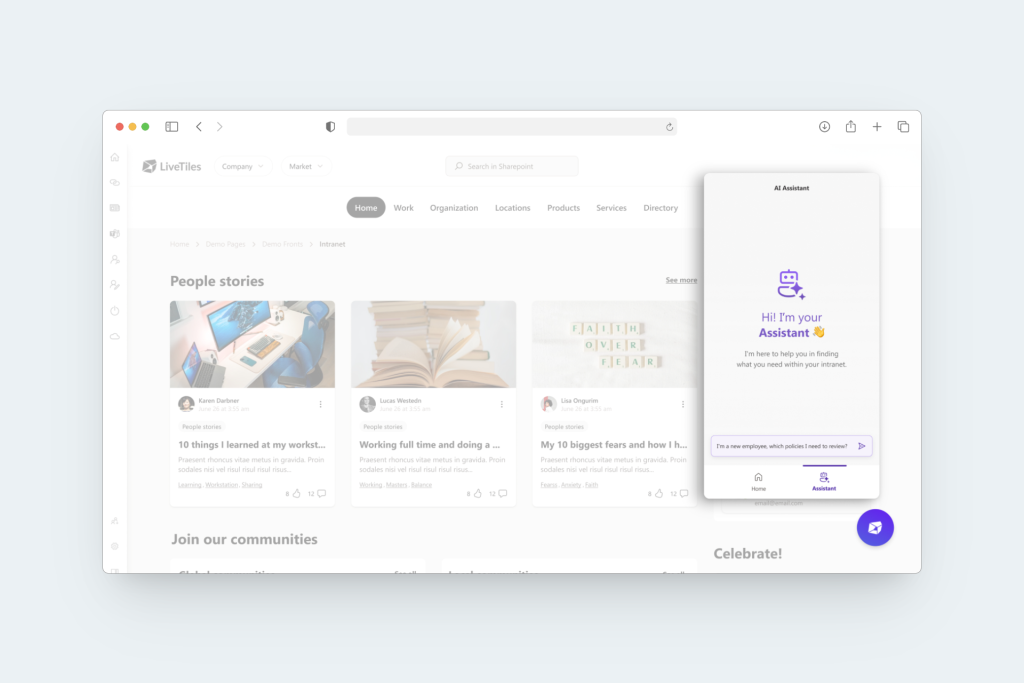
By the time LiveTiles brought its AI to market, every vendor in the Microsoft 365 intranet space had added “AI” to something, and most of it was the same chatbot sitting in the corner of the screen, waiting for someone to type the perfect question. LiveTiles had built something that actually behaved differently. Its Everywhere Widget worked across SharePoint, Teams, and the employee apps on its own, pulling the answer an employee needed before they went looking for it.
That difference was real, and it went invisible the moment a buyer filed us next to every other AI assistant on the shortlist. Once you land in that pile, the deal turns on price and feature counts, and that is the one comparison a smaller vendor never wins. So the problem I owned was not how to announce the product. It was how to change the category buyers measured it against, before the first demo loaded.
What I did
Positioning had to come before any asset got made, so I started with the market instead of the messaging.The distinction I bet on was agent versus assistant. An assistant waits for instructions. An agent works ahead of you.
That line was already the direction analysts were moving, so naming the product an agent used the market’s own language instead of fighting it. I would not stake a six month launch on a slogan, though, so I tested it.
I ran interviews with IT leaders and knowledge workers about how they used AI in a real working day, and the pattern held: people leaned on AI that anticipated the next step, and quietly abandoned the assistants that waited for a prompt after the first week. The safe alternative, a feature led launch built on productivity claims, would have spent the whole budget repeating what every competitor already said.
From there the work was keeping three regions telling one story.
A message map gave IT leaders, knowledge workers, and executives each their own version of the agent narrative without breaking it.
A GTM brief locked product, sales, and regional marketing onto the same bet before anyone wrote a line of copy. Content taught the agent idea before it asked anyone to buy, and sales enablement handed reps the research under the positioning so they could hold it in a hard room instead of reciting it.
The results
Adoption came in 2-3x higher than previous launches, with 30+ trials in the first month.
Industry analysts called the product innovative and groundbreaking and singled out the Everywhere Widget concept, third party validation that shortened credibility conversations in sales cycles.
The quieter result mattered more. Prospects arrived at sales conversations already understanding the agent distinction, so reps spent their time on implementation instead of education.
And the launch process itself became the template for the releases that followed, the beginning of what later grew into a full launch cadence for the company.
To be precise about attribution, the adoption multiple compares this launch against the company’s previous launches under comparable conditions. Positioning was one variable among several, but it was the one we changed.
If I ran this go to market today, the research phase would take days instead of weeks. I now run competitive analysis with AI agents and synthesize interview transcripts in hours, which is the point of working AI native: the mechanics get faster so the strategy gets the time.

You’ve read this far, why not take the next step?
I’m Zack, a product marketing leader for B2B software companies. If your product is better than your launch numbers show, that’s the problem I fix.
> Contact me here or find me on LinkedIn.
”Zack has a keen understanding of establishing the key elements for his digital outreach, to drive awareness and establish Siteimprove in Southern Europe.
Rie LindgrenHead of Marketing”He's a natural leader who understands the business environment and knows how to integrate people in a team. His main values are flexibility, discipline, and empathy.
Nil DaunisB2B Sales Manager”Zack has taught me a lot, not only about how to approach new challenges but how things happen to those who fight for them.
Carmen GarciaProject Analyst”Zack is a true doer! His motivation and outstanding hard work, along with his great understanding of Siteimprove’s customers made him a key asset in their Marketing team.
Nada ThoumierPartner Manager
Recent Projects
AI product launch: The GTM strategy behind a category win
AI product launch: The GTM strategy behind a category win
Read More
SaaS packaging and pricing case study